

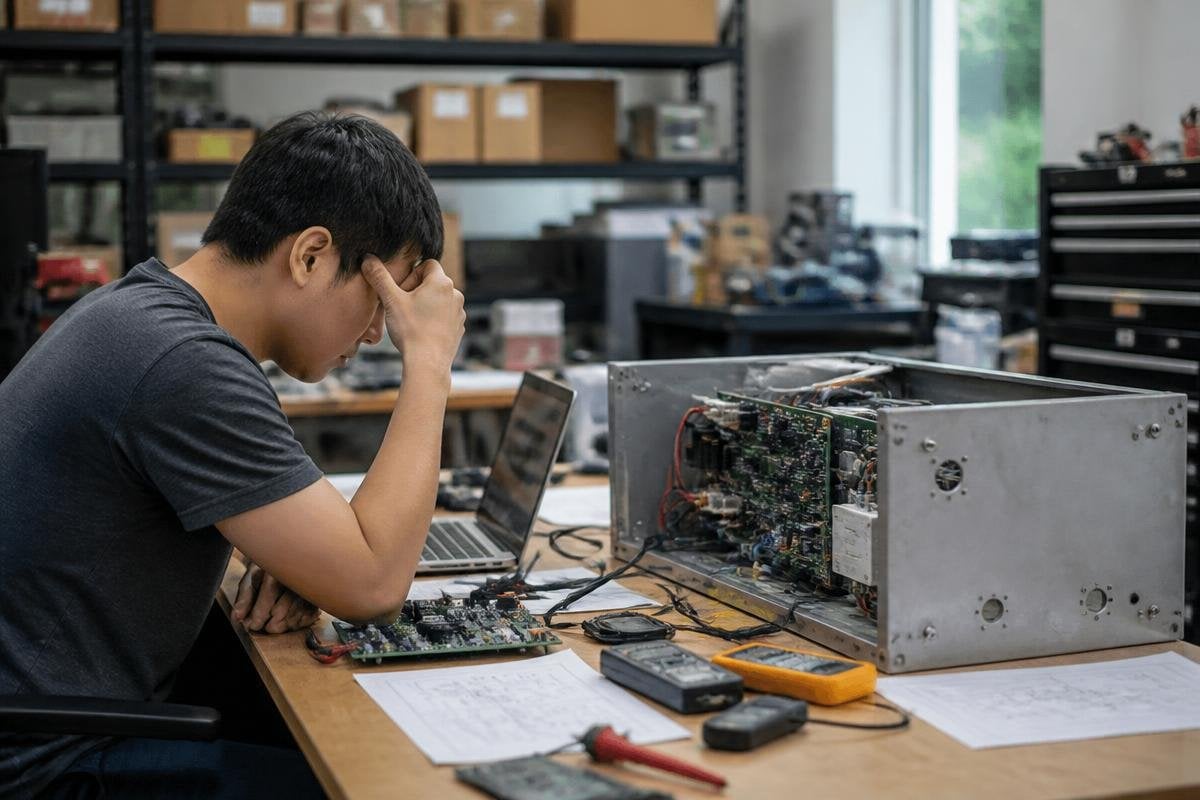
A software startup can fix a broken feature with a new build. A hardware startup may need a new circuit board, a new enclosure, and another production run before the same fix reaches a customer.
Quick read
- Hardware mistakes can create tooling, shipping, and warranty costs.
- A working prototype still needs testing, safety checks, suppliers, and repeatable assembly.
- Software can often sell before the product is finished; hardware needs money before the first sale.
The product exists in a physical world
Software runs on equipment someone else already owns. Hardware must fit inside a case, draw the right amount of power, survive heat and vibration, and work with parts that arrive from outside suppliers. Each condition adds a test that a software team can avoid.
A change to one part can affect the rest. A larger battery may extend runtime, but it can also make the robot heavier. That extra weight can call for a stronger motor, a larger motor driver, and a new frame. The change moves through the bill of materials, which is the full list of parts and their costs.
This is why a prototype proves less than many founders expect. It shows that one unit can work. It doesn’t show that a factory can build 1,000 units with the same fit, safety, and performance.
Manufacturing turns plans into bills
Software teams usually copy a finished product at a low extra cost. Hardware teams buy parts for every unit, pay for assembly, manage defects, and move finished goods through warehouses. A missed connector or a weak fastener can affect an entire batch.
Tooling adds another payment before sales begin. An injection mold for a plastic enclosure can cost far more than a hand-built prototype, and changing that mold after production starts can mean new design work and more downtime. A printed enclosure avoids that early cost, but it may not have the strength or finish needed for regular use.
Suppliers add their own timing. A company may need a custom motor, sensor, or battery pack, and the supplier may require a minimum order. That leaves money tied up in parts before demand is proven. Unsold stock can become a larger problem than a slow software release because it cannot be updated with a download.
Rules, service, and the sale
A robot that moves near people needs checks for electrical safety, moving parts, radio equipment, and the rules that apply in its market. The exact work depends on the product and country, but the work still needs time, documents, test samples, and people who know the required standards.
Customers also judge the company after delivery. A software bug may need a patch. A hardware fault can require a replacement part, a field visit, or a return shipment. That service plan becomes part of the product cost, even when the sales page leaves it out.
The gap matters in robotics because the buyer often needs proof inside their own site. A warehouse robot must fit the aisle, connect to existing systems, stop safely, and keep working after repeated shifts.
A lab demo can show motion. It cannot by itself show the cost of keeping that motion available every day.
A hardware company can spend months paying for parts, testing, and factory work before its first sale. Robot24.com’s robotics startup reporting gives you the company and machine details behind those delays, which sets up the cash problem that comes next.
Cash arrives late
Hardware startups spend heavily before revenue becomes dependable. They pay for design, prototypes, test units, tooling, parts, assembly, packaging, shipping, and support. Software can often charge early and improve the product after customers arrive. Hardware has fewer chances to make that sale before production costs land.
That timing changes the funding problem. A company may raise money to build its first batch, then need more money to fix defects or buy parts for the next one. If demand rises faster than the supply chain can respond, orders can grow while cash stays locked in unfinished stock.
The strongest opposing view is that hardware can build a lasting product customers cannot replace with a software update. That can be true, but the company still has to make the product, support it, and earn enough per unit to pay for those tasks. I’d rather back a hardware startup with a plain service plan and repeatable assembly than one with a polished demo and no repair path.
Check the plan before you build
Use this list when judging a hardware startup or planning your own product:
- Repeatable build: Can another team assemble the product from documented instructions?
- Part supply: Does each custom component have a second source or a tested replacement?
- Unit cost: Does the price include assembly, packaging, shipping, support, and warranty work?
- Safety work: Which tests and standards apply in the first sales market?
- Field repair: Can a technician replace the failed part without returning the whole product?
- Cash timing: Can the company pay for the next production run before customers pay invoices?
These answers show where the risk sits. A working prototype earns the next test, not the right to skip manufacturing, service, or cash planning.
The hardware startup that survives is the one that treats every unit as a long chain of parts, tests, suppliers, and support. Software can delay many of those costs; hardware has to meet them before the first box ships.
